
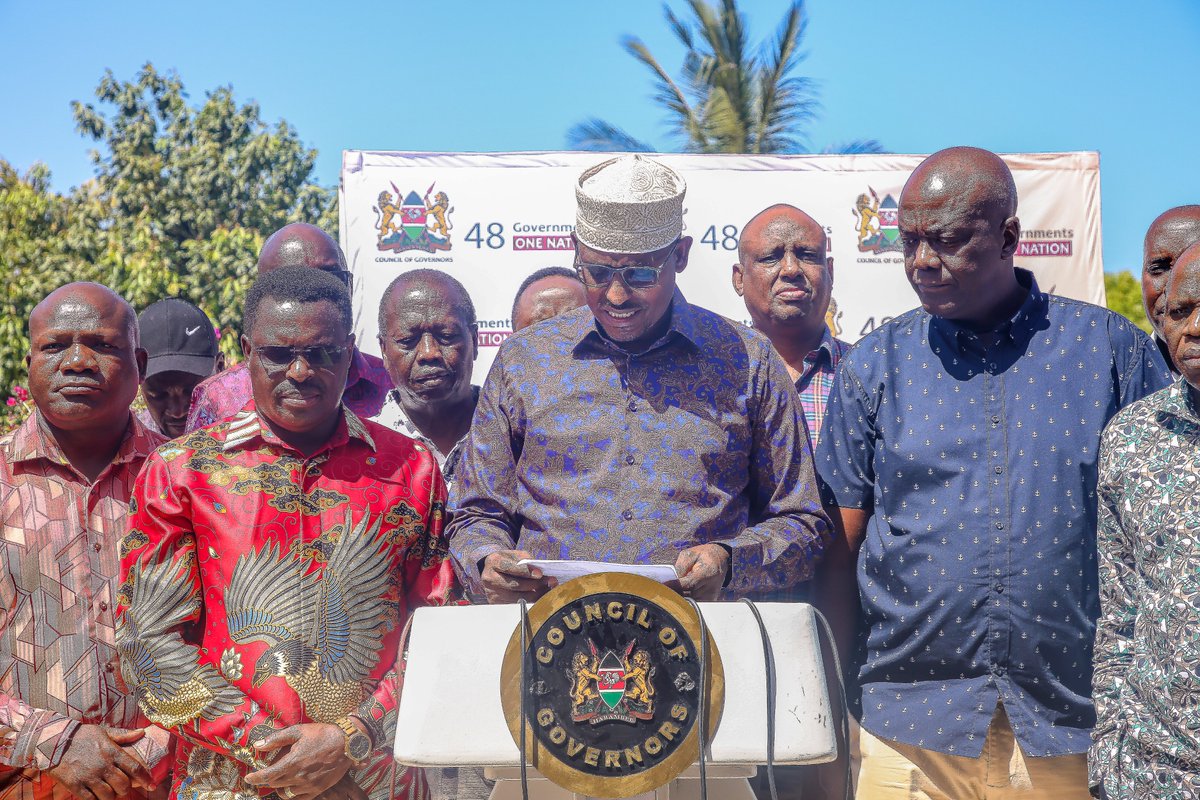
The Council of Governors is urging Parliament to urgently pass the Public Finance Management (Amendment) Bill, 2025, warning that continued delays in its enactment could derail the smooth flow and use of conditional grants to county governments, and disrupt development projects in the upcoming financial year.
In a detailed legislative memorandum presented to the National Assembly of Kenya Finance and National Planning Committee, the governors push for the removal of Sections 191A to 191E of the Public Finance Management Act, describing them as unworkable and poorly aligned with devolution needs. They argue that the provisions have remained unimplemented for years, creating confusion in the management of county funds.
“The Public Finance Management (Amendment) Bill… is critical to the County governments as it seeks to enhance efficiency in the transfer and utilization of funds emanating from various conditional grants,” the memorandum states.
The Council of Governors, which brings together all 47 county governments, also acknowledged Parliament’s engagement on the matter, noting its “renewed collaboration in ensuring matters affecting Counties and devolution are addressed.”
Despite this engagement, the governors say implementation has remained a challenge, even after several attempts with the National Treasury to operationalise the disputed sections.
“The Council governments have, in collaboration with the National Treasury, attempted to implement the new Sections of the PFM Act unsuccessfully,” the memorandum states, adding that the provisions have already been suspended by Parliament for five consecutive financial years.
The governors further note that a multi-agency taskforce under the National Treasury recommended the repeal of the sections, a position later supported by the Intergovernmental Summit.
A key concern raised is what the Council describes as unnecessary duplication in how conditional grants are managed. It argues that existing Intergovernmental Participation or Partnership Agreements already provide a framework for managing the funds, making additional agreements redundant.
“The requirement for the Intergovernmental Agreements is unnecessary and should be deleted,” the Council noted, adding that such duplication “would result to duplication of efforts leading to delays in project implementation.”
The memorandum also raises concerns over the role of the National Treasury in oversight, arguing that this responsibility should lie with the relevant ministries, departments and agencies.
“The MDAs are responsible for setting the conditions precedent and the day-to-day monitoring as opposed to the National Treasury as Section 191A suggests.”
On public participation, the governors fault the current framework, saying it comes in too late in the process to be meaningful. According to them, this weakens citizen involvement in decision-making on conditional grants.
The Council also points to a mismatch between the proposed agreements and the national budget cycle, noting that agreements are required after Parliament has already approved conditional allocations. It also argues that county assemblies already exercise oversight through approval of fiscal strategy papers and budget estimates, making additional approvals unnecessary.
Overall, the governors say repeated failure to implement the provisions since the 2021/22 financial year reflects deeper structural problems in the law.
“The Council therefore proposes that the Bill is passed by Parliament without amendments before the beginning of the FY 2026/27,” the memorandum urges.
They warn that further delay could affect the release and use of funds, risking delays in development projects across counties.
“The Council urges the National Assembly to consider the Bill expeditiously to ensure that the additional allocations of the ensuing FY are not affected,” the memorandum notes.
The push by the Council of Governors highlights ongoing friction between county governments and national institutions over financial control and coordination, especially within Kenya’s devolved system.





















Comments
Sign in with Google to comment, reply, and like comments.
Continue with Google